 A few words in terracotta about a small native land
Erma Pantheon Valdagnensis
A few words in terracotta about a small native land
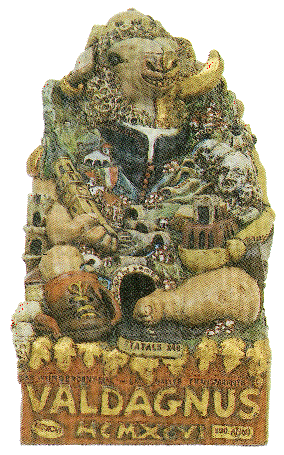
Valdagno is a small town in the Veneto region (about 27,000 inhabitants) lying in the high Valley of the river Agno, 30 km north-west of Vicenza. Its history does not date back to ancient times. It was never a Roman settling and was first transformed into a village by people from the Po Region. Only afterwards was it inhabited by others coming from places beyond the Alps who settled on the slopes where they transformed the woods into arable fields and pasture-lands. The German spoken language ("cimbro") remained -- at least in the villages on the outskirts -- until the 17th century and is still witnessed in the place-names. The village became important as a passage junction from the Po Valley -- through the Campogrosso pass -- to the Adige valley and from there northwards. Its name appeared for the first time around the late 12th century. Therefore in 1996 it was able to celebrate its 800th anniversary with a certain amount of accuracy. On this occasion two local cultural figures (Luciano Lora for the modelling and Domenico Franceschi for the ideological and critical part) imagined and realized a terracotta work, Erma Pantheon, representing the things, the people and the events of their native town. This did not turn out to be a celebration or a rhetorical work, but something rather nostalgic, ironic and grotesque. The symbol of the Town Hall is a Lamb by a river, therefore an ovine was chosen as the main figure of the statue; the right half of its snout has been portrayed as a Lamb, symbolising the bourgeoisie gathered around the old "Piassa" (the square used by local merchants and craftsmen) and the archpriest's church of S. Clemente, while the left half of its snout has been portrayed as a Ram, symbolising the Marzotto Family that in the last 150 years has characterised the history of the place, changing it from a rural centre and a spa into a modern and industrial town, i. e. the new part of Valdagno on the left side of the Agno (1930-1955). Behind these snouts you can see the merry face of a strange puppet, "El Puòto Sgarabòto", representing the humorous and transgressive spirit of the common people. A naked woman sits by the heads: Anguana Rotolona (a local mythical nymph whose name derives from Rotolon, one the sources of the Agno above Recoaro) who holds an amphora from which water pours, flowing down the valley and thereby forming the entire course of the Agno down to the plain. The body of the statue represents a human body sitting like a Buddha who on his right arm holds the Bell Tower of the church of S. Clemente and on his left arm the hierarchy of the Marzotto Family. On its groin, a hole opens and stands for the tunnel which in the near future will join Valdagno and Schio, an important centre of the nearby valley of the Leogra river. Along the walls of the statue you can see the façades of different buildings, heraldic symbols and inscriptions. On the back, a xeroxed table shows a list of names -- notable figures and common people --, words, associations etc. that have lived in the community. The 25 statues produced weredecorated in different colours and styles: from popular realism to liberty or abstract decoration starting from famous examples of 20th century art.
 le 25 versioni commentate Indice